Shopify SEO Checklist 2026
Category: SEO
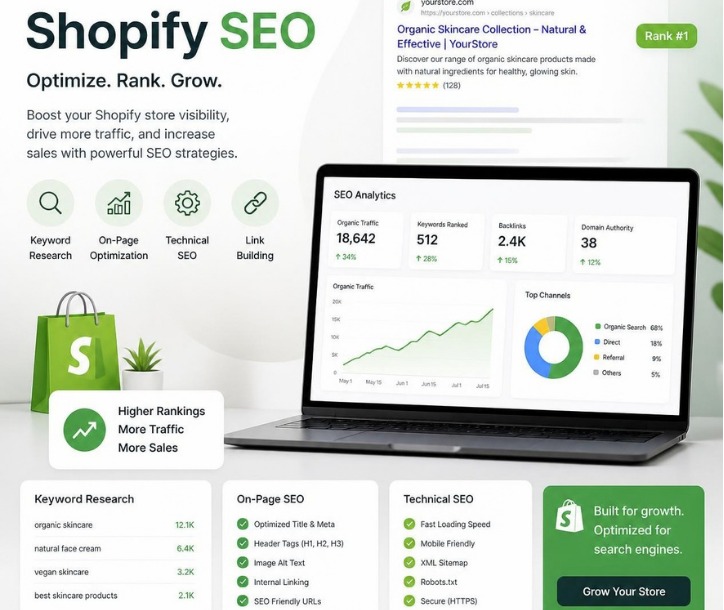
Quick answer: A complete Shopify SEO checklist for 2026 covers four layers: technical foundations (site speed, indexing, mobile usability), on-page optimization (titles, product descriptions, internal linking), content strategy (blog posts, buying guides), and AI search visibility (structured data, FAQ schema). Work through each layer in order, then treat it as an ongoing quarterly review.
Shopify now powers roughly 6.9 million active stores worldwide. That’s not a reason to panic about competition — it’s a reason to stop treating SEO as a one-time setup task. The stores winning organic search in 2026 aren’t spending the most on ads; they’re the ones treating SEO as continuous, structured work. This checklist walks through exactly what that looks like, organized so you can work through it section by section without missing anything important.
1. Fix Your Technical Foundation First
Technical SEO is the layer everything else depends on. If Google can’t crawl and index your store properly, content and keywords won’t matter.
- Check crawlability and indexing. Confirm your robots.txt and sitemap.xml (both auto-generated by Shopify) aren’t accidentally blocking important pages.
- Audit your app stack. Every unused app is unnecessary script weight slowing your store down — remove anything you’re not actively using.
- Fix mobile usability. Most shoppers browse and compare on mobile; buttons should be easy to tap, images should load quickly, and checkout shouldn’t feel cramped.
- Improve page speed. Shopify gives you HTTPS and mobile-friendly themes out of the box, but speed still depends heavily on your theme, app choices, and image sizes.
2. Get Keyword Research Right Before Touching a Single Page
Strong SEO starts with knowing what your customers actually search for — not what you assume they search for.
- Build a keyword list using Google Keyword Planner or a similar free tool.
- Separate keywords by intent: transactional keywords (ready-to-buy language) belong on product pages, commercial-intent keywords (comparison, “best of” language) belong on collection pages.
- Assign one primary intent per page. A page trying to rank for everything usually ranks for nothing.
3. Optimize On-Page Elements Product by Product
Shopify’s rigid URL structure (/products/, /collections/, /pages/) means your SEO energy should go into content quality, not URL engineering.
- Write original product descriptions — features, benefits, sizing, materials, care instructions, and FAQs — instead of manufacturer copy every competitor is also using.
- Follow Google’s image guidance: descriptive alt text, fast-loading formats, and images that actually match the surrounding content.
- Keep meta titles and descriptions specific to each page rather than reusing templates across your catalog.
4. Build Content That Actually Earns Links
Product and collection pages rarely earn backlinks naturally — they’re transactional, not the kind of thing other sites want to reference. The content that earns links and gets cited in AI Overviews is different:
- Buying guides (“How to choose trail running shoes”)
- Original data or research specific to your industry
- Comparison content between products, categories, or approaches
Publish at least two SEO-targeted blog posts per month, and link each one to the collection or product page it naturally supports.
5. Structure Your Site for Both Customers and Search Engines
Internal links guide shoppers through your store and help search engines discover important pages. A blog post about “how to choose running shoes” should link directly to your running shoe collection — this spreads authority across your site, reduces orphan pages, and moves customers naturally from information to purchase, which directly supports conversion rate optimization efforts further down the funnel.
6. Prepare for AI Search Visibility, Not Just Google Rankings
AI-powered search is reshaping discovery, but it hasn’t replaced traditional search — Google still sends roughly 210 times more traffic than ChatGPT, Gemini, and Perplexity combined, according to 2025 Ahrefs data cited by TinyIMG’s 2026 Shopify SEO research. The right approach is optimizing for both, not choosing one over the other.
- Add FAQ schema to blog posts and product pages answering common buyer questions — this increases eligibility for both featured snippets and AI-generated answers.
- Structure content in clear, direct-answer formats that AI systems can extract cleanly.
- Don’t abandon traditional on-page SEO to chase AI visibility; the two are complementary, not competing priorities.
7. Track, Review, and Repeat
The first pass through this checklist will take the longest. After that, treat it as a monthly or quarterly review:
- Monitor performance in Google Search Console.
- Review which pages have dropped in rankings or traffic.
- Check which competitor pages are outperforming yours and identify what they’re doing differently.
- Keep content current — outdated statistics and old product years quietly hurt trust and rankings.
The Bottom Line
Shopify SEO in 2026 isn’t about sprinkling keywords on product pages. It’s about building a store that search engines can crawl, users can trust, and buyers can navigate without friction — then treating that as ongoing work rather than a one-time setup. Stores that follow a structured checklist like this one rank faster, convert better, and recover from algorithm updates more reliably than stores treating SEO as an afterthought.
Closing CTA
Not Sure Where Your Shopify SEO Actually Stands?
We’ll audit your store against this exact checklist and show you what’s holding back your rankings — technical, on-page, content, or all three.
CTA Button: Get a Free SEO Audit
Shopify provides a solid technical foundation — HTTPS, mobile-friendly themes, and automatic XML sitemaps — but the platform alone won’t rank your store. On-page optimization, content, and ongoing technical maintenance still require active work.
No. While AI-powered search is growing in importance, Google still sends roughly 210 times more traffic than ChatGPT, Gemini, and Perplexity combined, according to 2025 Ahrefs data. The best strategy optimizes for both.
After an initial full audit, a monthly or quarterly review is enough to catch ranking drops, outdated content, and new competitor activity before they become bigger problems.
Trending Articles

10 Shopify Mistakes That Kill Sales
July 10, 2026
Ecommerce Trends to Watch in 2026 (For Shopify Brands)
July 10, 2026
Modern UI/UX Principles: A Shopify UX Audit Case Study
July 10, 2026
Recommended for you
Shopify Theme Customization vs. Custom Development: Which One Actually Fits Your Store?
Quick answer: Theme customization means modifying an existing theme (like Shopify’s Dawn)…
Read More →
Modern UI/UX Principles: A Shopify UX Audit Case Study
Category: Web Design | July 10, 2026 Many ecommerce businesses focus heavily…
Read More →
Ecommerce Trends to Watch in 2026 (For Shopify Brands)
Quick answer: The ecommerce trends actually shaping 2026 include agentic commerce (AI…
Read More →